
STRAYTUKAY: Chaos, Couture & the Dark Glamour Pipeline
- Feb 16
- 2 min read
Cal also known as @STRAYTUKAY doesn’t just get dressed — they construct looks the way a set designer builds a stage. Every outfit is engineered, every silhouette considered, every texture chosen with the understanding that clothing is not decoration but narrative. In their universe, fashion is performance, identity, armour, and punchline all at once.


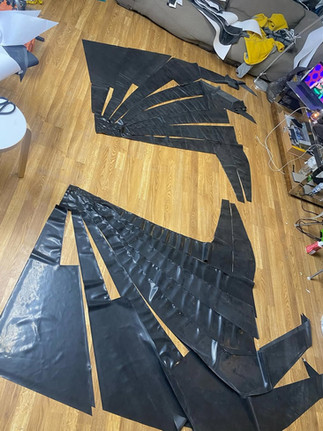
Long before the camera turns on, there’s process. Sketching, sourcing, draping, cutting, reworking — the quiet, obsessive labour that sits beneath the hyper-polished images. STRAYTUKAY’s approach to design feels instinctive but never accidental. Garments are often reconstructed rather than simply styled, pulled apart and reassembled until they carry the exact emotional charge required. A sleeve becomes a sculpture. A basic piece mutates into something theatrical. Proportion is pushed, waists shift, shoulders expand, fabrics are forced into new behaviours.


There’s a clear dialogue with the language of avant-garde fashion — and the gravitational pull of Rick Owens is unmistakable. Not as imitation, but as alignment. That same devotion to silhouette, to shadow, to the body as architecture. The Rick Owens universe — all brutal elegance, elongated forms, and sacred darkness — finds a natural translator in STRAYTUKAY, whose work understands that drama lives in restraint as much as excess.

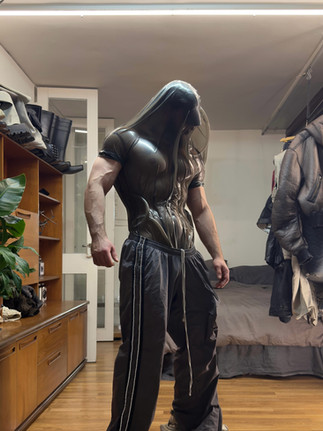


Their pieces carry that tension: glamour versus distortion, polish versus ruin. A look might begin with something traditionally “beautiful,” only to be twisted into something uncanny — stretched, layered, sharpened, made slightly dangerous. It’s fashion that refuses to sit still for the male gaze, instead building its own mythology.
What makes STRAYTUKAY’s design process so compelling is its emotional starting point. These are not clothes made to follow trends; they’re made to capture a mood. Each finished look feels like a character study — a specific persona summoned for a specific moment. The result is a body of work that exists somewhere between runway, performance art, and digital self-portraiture.




And then there’s the translation from physical garment to image. Cal understands how clothing lives on camera — how movement, lighting, and framing complete the design. The final post is never just documentation; it’s the finished artwork, where styling, pose, and environment lock together into a single, controlled visual hit.
In a moment where fashion cycles are accelerating and originality is constantly diluted, Cal operates differently. Slower. More deliberately. Building looks that feel authored rather than consumed.




The Rick Owens connection makes perfect sense because both practices treat clothing as a philosophical object. Not just something to wear, but something to become. That shared language of transformation, monumentality, and emotional darkness runs through STRAYTUKAY’s work like a spine.


What we’re watching isn’t content creation — it’s world-building through fabric, proportion, and persona. @STRAYTUKAY designs for the image, for the body, and for the mythology of the self.
And in the Context universe, that’s the highest form of fashion.


Comments