
Sean Brady: Face Architect, Fantasy Builder, Beauty Futurist
- Nov 14, 2025
- 3 min read
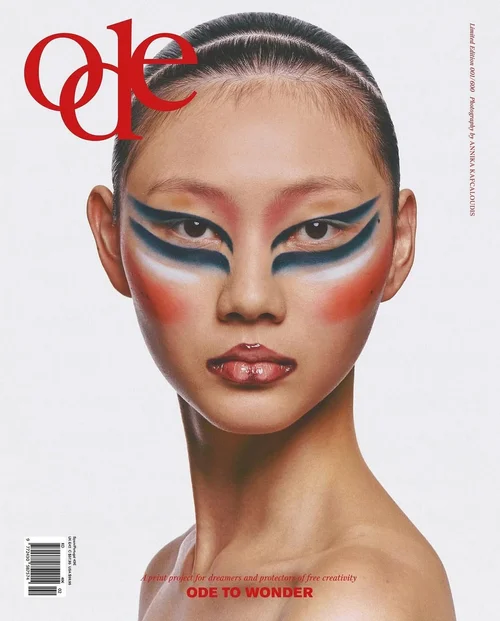


There are makeup artists who perfect technique, and then there is Sean Brady—an artist who treats the face like a living landscape, a surface where emotion, story, and structure collide. His looks aren’t just “beauty”; they’re blueprints for alternate worlds. Brady’s makeup doesn’t sit on skin—it erupts from it, blurring the line between human and creature, fashion and fiction, glamour and myth.
What makes Sean compelling is that his rise wasn’t manufactured through the usual beauty-industry conveyor belt. He didn’t come up through a formal makeup course or as an assistant in a conventional studio. His training ground was curiosity, solitude, and experimentation. He began by painting on himself and close friends, using his own face as a lab for colour, texture, and transformation. From the start, he wasn’t trying to replicate trends—he was trying to understand how a face could become something else entirely.


In those early experiments, you can already see the DNA of the artist he is now. Sean has always been drawn to symmetry, structure, and exaggeration—not as decoration, but as architecture. His designs curve around cheekbones like exoskeletons, elongate the eyes into alien forms, or stretch colours across the face in sculptural, almost topographic ways. His work is less about “correcting” features and more about uncovering a secret language written beneath them.
As his practice developed, so did his instincts. Sean approaches each face like a territory with its own weather system. He studies the angles, shadows, tension, softness. He listens. His process is intuitive—he often begins before he fully knows where he’s going. A line suggests another line; a shadow grows into a structure; a colours becomes a mood. His artistry is part improvisation, part engineering.
What sets Brady apart from many beauty creatives is his relationship to imagination. His inspirations aren’t taken from traditional makeup references—they’re drawn from biology, horror films, mythology, natural textures, creature design, and emotional tone. A look might come from the vulnerability of an exposed muscle, the sleek symmetry of an insect, or the quiet menace of a character from a film he saw years ago. But by the time those influences move through his hands, they become entirely his.





Professionally, Brady moves fluidly between editorial, fashion, and conceptual work. His collaborations with photographers, stylists, and models have given him space to push the limits of what makeup can express. In editorials, he often transforms models into beings that feel part-human, part-sculpture, part-symbol. There’s a boldness, but also a softness—a sense that even the most extreme looks still carry tenderness.
And while his work is visually striking, it’s also deeply emotional. Brady paints moods. His makeup often feels like the physical manifestation of a feeling: longing stretched into a line, fear translated into shadow, joy exploding as colours. He has a rare ability to use the face as an emotional amplifier.


As his profile grows, so does the scale of his ambition. Sean’s next chapter seems poised to move beyond beauty entirely—toward full visual worlds that include prosthetics, character design, storytelling, and immersive experiences. His artistry is expanding from makeup into something closer to fantasy construction.
But the core of his practice remains unchanged: he honours the face. He respects its natural architecture. He finds beauty in distortion, in exaggeration, in vulnerability. He understands that makeup can be a ritual as much as an art form—an invitation to become a new version of yourself, or an honest version of how you feel inside.


In a beauty landscape dominated by trends, algorithms, and safe formulas, Sean Brady is a necessary disruptor. His work reminds us that makeup can be a portal, not just a product. That a face can be a story, not just a surface. And that the future of beauty belongs to artists who dare to dream beyond symmetry, beyond perfection, beyond the mirror.
Sean isn’t following the rules. He’s writing his own—and they’re far more interesting.


Comments