
Lucia Neamtu’s Marble Dreams Drift into Milan
- Apr 26, 2025
- 4 min read
Updated: Apr 28, 2025
Marble isn’t supposed to move. But in Soft Reflections, Lucia Neamtu dares it too. Lucia Neamtu, a Moldovan-born designer based in New York, brings a curator’s eye and a poet’s restraint. Her world is one of softness carved into strength. And in Milan, that softness shimmered.
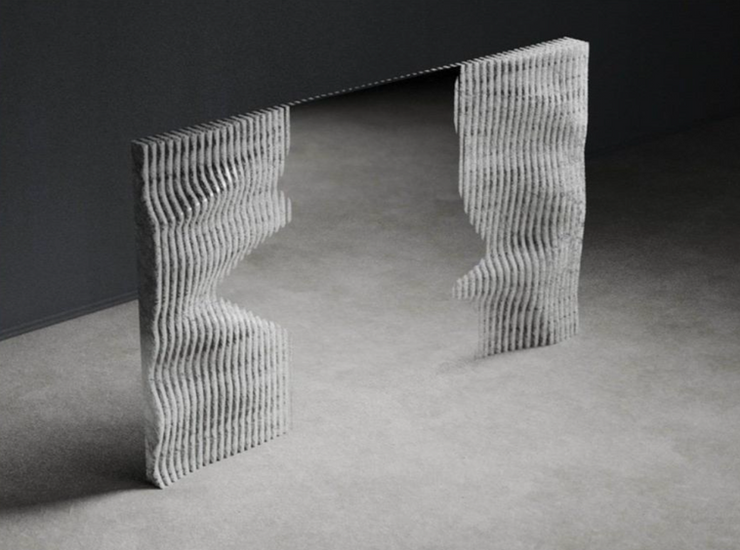
Unveiled at this year’s Alcova during Milan Design Week 2025, Neamtu’s newest collection hums with contradiction—fluid lines cut into unforgiving stone, soft curves held within centuries-old marble. It's a visual whisper of the Ligurian Sea, captured and stilled.
Each piece—mirrors, lamps, low-slung tables—feels like a sculpture mid-exhale. There’s grace here, but also mischief. The Murano glass elements, hand-blown in Venice, appear to melt over the marble like silk robes slipping from a shoulder. It’s tactile seduction, cloaked in restraint.

Crafted in partnership with Bufalini—a Carrara-based marble studio that’s been shaping stone for over 300 years—the collection carries a rarefied weight. Not just in its materials, but in its presence. This is furniture that knows how to hold a gaze. A new friend to Context we get to ask Lucia questions about her otherworldly pieces…
Your work sits at the intersection of design and fine art—do you think of yourself as a sculptor, a designer, or something else entirely?
I’d say I’d lean toward thinking of myself as a fusion of all those roles. My work definitely has a sculptural element, especially when I’m shaping materials and thinking about form in an artistic way. But at the same time, design is a huge part of what I do—there’s a function and purpose behind everything I create, and that’s where the designer in me comes out.
It’s kind of like blending aesthetics and utility. The lines between sculpture and design can blur a bit, especially when you're trying to create something that both elevates a space and serves a function. So, in a way, I feel like I’m occupying a unique space that doesn’t fully fit into one box. Maybe I’m a "functional sculptor" or a "design artist," if that makes sense!


How do you hope people feel when they live with your pieces? Do you think about intimacy in design?
Absolutely. It’s all I’m aiming for. I come from fashion and I left because I wanted to create something more real, more tangible and something that will stay with you forever. That’s another reason I chose stone and marble or work with the most durable material that’s out there. You get one of my pieces and you will have it for generations and how I like to joke about it, there can be an earthquake or your house will burn down but you will still have my pieces standing and with no damage.
How did your collaboration with Bufalini and the Murano artisans shape the collection?
Two years ago, I traveled to Carrara in search of a marble manufacturer, but I couldn’t quite find the right fit. Then, through a mutual friend, I was introduced to Alberto Bufalini. We immediately clicked, and he was eager to collaborate with a new artist. Since then, we’ve been working together for two years, building a beautiful relationship. I visit Carrara often, and we regularly go out for dinner with him and his sister and just feels my extended family. It’s more than just work, it feels like a genuine friendship, very much in line with the warmth of the Italian way of life.


With Murano glass I just started this year but I’ve always been so mesmerised by it. Glass blowing in Murano is an artistry that’s been a revered art form for centuries, deeply rooted in the history of Venice. What’s so special about Murano glass is not only its beauty but also the methods and secrets that have been passed down through generations of artisans. Another aspect about it that I’m very passionate about is the sustainability aspect of glassmaking, as Murano artisans have traditionally used recycled glass, which aligns well with modern concerns about environmental impact. But today this old tradition is fading, taking with it not just beautiful objects, but a vital piece of cultural heritage. I don’t want this art to die and support it as much as I can .
Do you see your materials—marble, onyx, glass—as characters? Do they have personalities you work with or against?
That's such an interesting question! And now that you make me think about it, I do see them as characters and definitely big personalities. Marble, for example, feels regal and solid—there’s something almost timeless about it. It has a weight to it, both literally and metaphorically. Onyx, on the other hand, feels more mysterious and moody.It invites light and shadow in a way that makes it feel alive, like it has its own stories to tell. And glass? Glass is an impostor, fragile yet powerful, with the ability to reflect or distort light in mesmerizing ways.
I think of them less as “characters” I work against, but more like partners in a conversation.Sometimes, the material leads you in a direction you didn’t plan, and that’s when the magic happens and creating the very unique pieces




What was the most difficult piece in the collection to bring to life?
The most difficult but so fascinating to make I think it was the Murano glass, the work that’s been put to make even one piece is incredible. I watched the glass masters working on one piece for hours and it was so enchanting, can’t compare their skill to
anything else I’ve seen before. The way it’s made is almost like a performance—each piece is shaped by hand, often while the glass is molten and glowing with heat. The craftsmanship is an incredible example of art in its purest form.


There's a surreal quality to your forms, almost like dream architecture. Do your ideas come more from the subconscious or the structural?
Both. A lot of my ideas come from my subconscious, like I dream them, fantasize then transform them into reality.
There’s definitely a dream-like, intuitive side to my process, where I let my mind wander and explore abstract forms. That’s where the surreal quality comes in—things that don't quite make sense, or that feel like they’re from another reality, start to emerge.
But at the same time, I’m very aware of the structural side. I have to think about how things will be built, how materials interact, and how something can be both art and function. It's a dance between the two, I’d say. The subconscious gives me the freedom to imagine the unreal, and the structural aspect grounds it in something that can exist.


Comments