
Andrea Ferrero: Pleasure, Impact, and the Architecture of Play
- Feb 22
- 2 min read
Andrea Ferrero’s sculptures look like they’ve been stolen from a playground and rebuilt for an emotional battlefield. A swing, a slide, a structure that suggests movement, balance, or concentration — the visual language is instantly familiar, almost childlike. But the feeling is not soft. These works hold weight, resistance, and a carefully controlled sense of danger.

What makes Ferrero’s practice so magnetic is this collision between fun and brutality. The forms reference play — the first spaces where we learn risk, trust, competition, and fear — yet the materials and construction refuse nostalgia. Metal feels heavier than it should. Angles are sharper. Surfaces are too precise, too polished, too controlled to belong to innocence. These are playgrounds after the loss of innocence.


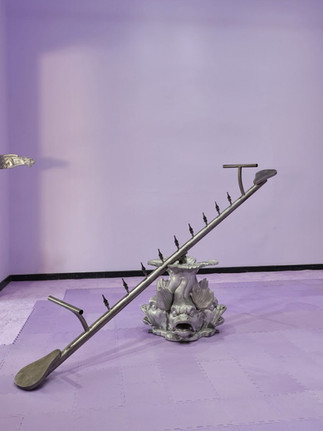


The swing doesn’t simply invite motion; it becomes about suspension — about the body held in tension between freedom and impact. The slide stops being a symbol of joy and turns into a controlled fall, a choreography of gravity. “Concentration” reads like a physical diagram of pressure: balance as endurance, play as discipline.

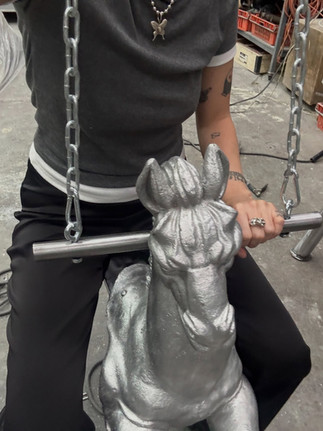


There’s a brutalist tenderness to the way she builds. Industrial materials carry a bodily presence — you feel their temperature, their density, their potential to bruise. And yet the colours, the curves, the visual clarity pull you back into something seductively clean and almost euphoric. It’s this push and pull that defines the work: attraction and threat, pleasure and control, memory and confrontation.

In a wider sense, Ferrero is dissecting how we’re taught to inhabit space and how early those lessons begin. Playgrounds are the first architectures we experience physically — the first time we understand scale, height, falling, waiting, taking turns, being watched. By isolating and transforming these structures, she turns them into psychological devices.


For Context, this reads as choreography for the body in a post-innocent world. These are not sculptures you simply look at — you measure yourself against them. You imagine the movement, the risk, the impact. You remember what it felt like to play, and you realise how much of that play was already about control.


Andrea Ferrero builds objects that seduce you with the promise of joy and then hold you in a space of tension. Fun becomes form. Brutality becomes design. And somewhere between the two, the viewer becomes the missing body the work is waiting for.


Comments